
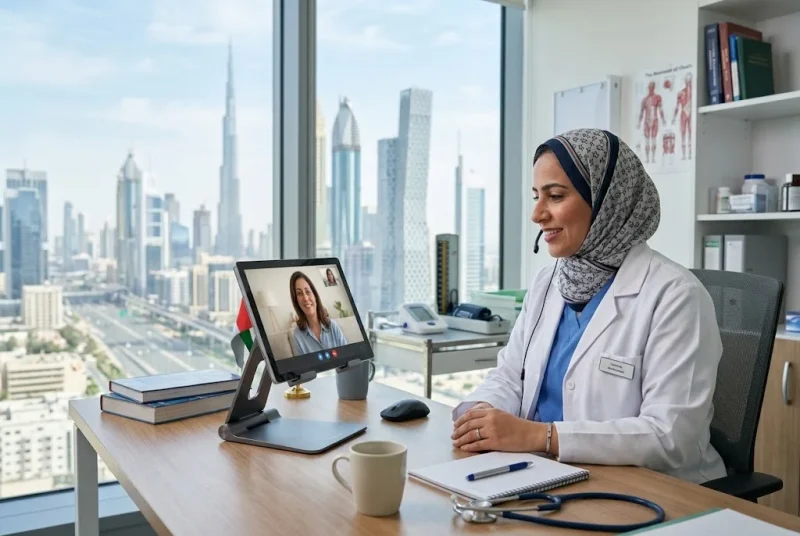

Telemedicine growth in UAE is changing how patients access healthcare, how medical professionals deliver consultations, and how healthcare businesses develop digital services. Through video consultations, remote follow-ups, electronic health records, and connected medical technologies, healthcare providers can offer selected services without requiring every interaction to take place inside a clinic. For patients, this can improve convenience and access; for businesses, it creates opportunities in virtual care, healthcare software, remote monitoring, and digital patient support.
The UAE’s established healthcare infrastructure and focus on digital transformation provide a foundation for further development. Dubai, in particular, has an established telehealth framework and public digital healthcare services. However, telemedicine is a regulated healthcare activity, not simply a video-calling service. Providers must consider professional licensing, facility approvals, clinical suitability, patient consent, information security, and the rules governing prescriptions and medical records.
This guide explores the main drivers of telemedicine growth in UAE, its business opportunities, the regulatory considerations for healthcare providers, and the practical steps organisations can take to develop safe and sustainable virtual healthcare services.
What Is Telemedicine and How Does It Work in the UAE?
Telemedicine uses digital communication technologies to deliver selected clinical services remotely. Depending on the service and its authorisation, a patient may consult a doctor through video or another approved communication method, discuss symptoms, receive follow-up care, or obtain instructions for further assessment.
Telehealth is a broader term that can include clinical consultations, remote patient monitoring, digital health education, and other health-related services. Telemedicine generally focuses on clinical care delivered remotely, although the terms are sometimes used interchangeably.
In the UAE, virtual healthcare operates within the relevant federal and emirate-level regulatory frameworks. Dubai has published dedicated telehealth policies and standards through the Dubai Health Authority (DHA), while federal legislation addresses the use of information and communication technology in healthcare.
These frameworks matter because a remote consultation must meet appropriate clinical and professional standards. A digital platform can facilitate communication, but it does not automatically authorise a company or individual to provide medical services.
Why Is Telemedicine Growth in UAE Accelerating?
1. Greater Demand for Convenient Healthcare
Patients often want healthcare services that fit around work, family responsibilities, and daily schedules. For suitable conditions, a remote consultation can reduce the need to travel to a clinic simply to discuss symptoms, review progress, or receive follow-up advice.
This convenience can be particularly valuable for patients who live far from a suitable provider or have difficulty travelling. Nevertheless, remote care is not appropriate for every condition. A clinician must determine whether a virtual consultation is sufficient or whether an in-person examination is necessary.
2. Digital Transformation Across Healthcare
Healthcare providers increasingly use digital systems to manage appointments, patient information, communication, and administrative processes. Telemedicine can build on this infrastructure by connecting patients with qualified professionals through authorised digital channels.
Dubai’s public healthcare information portal describes the Dubai Health Authority’s Doctor for Every Citizen telehealth service, which offers consultations through voice and video calls. This demonstrates how remote healthcare has become part of the emirate’s broader digital service ecosystem.
For private providers, the opportunity is to identify where virtual consultations can complement existing clinical services without compromising quality or continuity of care.
3. Demand for Follow-Up and Chronic Care Support
Some patients need regular follow-up appointments to discuss symptoms, review treatment progress, or manage long-term conditions. When clinically appropriate, telemedicine can make these interactions easier to schedule and attend.
Remote care may also support selected chronic disease management programmes when combined with appropriate monitoring, clinical review, and escalation procedures. It should not replace necessary examinations, diagnostic tests, or urgent treatment.
4. Growth in Healthcare Technology
Healthcare providers can use digital platforms to coordinate consultations, maintain appropriate records, and communicate follow-up instructions. Some systems also incorporate analytics or AI-assisted administrative features.
Businesses interested in this area can explore our guide to AI in the UAE healthcare industry. AI and telemedicine can complement each other, but clinical decision-support tools require appropriate validation, oversight, and regulatory assessment.
Main Types of Telemedicine Services in the UAE
Virtual Doctor Consultations
Virtual consultations allow patients and healthcare professionals to communicate remotely for appropriate clinical assessments, advice, and follow-up. Depending on the circumstances, the clinician may request additional information, recommend diagnostic tests, arrange a referral, or ask the patient to attend a physical facility.
Providers should establish a clear process for confirming patient identity, obtaining appropriate consent, documenting the consultation, and identifying situations that require urgent or in-person care.
Remote Patient Monitoring
Remote patient monitoring involves collecting selected health information outside a conventional clinical setting and making it available to an authorised healthcare team. Depending on the programme, this may involve measurements from approved devices or information submitted by the patient.
Potential applications include monitoring selected indicators for patients with long-term conditions. However, a monitoring system must define who reviews incoming information, how frequently it is checked, and what action is required when readings or symptoms raise concerns.
Teleconsultation for Specialist Follow-Ups
Some specialist follow-up appointments may be suitable for remote delivery, particularly when the clinician already has relevant medical records and no physical examination is required. This can help patients discuss progress and receive further instructions without unnecessary travel.
Suitability must be assessed individually. A remote appointment should not delay diagnostic procedures or face-to-face evaluation when these are clinically necessary.
Digital Health Education and Patient Support
Healthcare organisations can use approved digital channels to provide general health education, appointment instructions, reminders, and information about care pathways. These services may improve communication and help patients understand what to expect before and after an appointment.
Businesses must distinguish general educational content from personalised medical advice. Patient-specific recommendations should be provided through an appropriately authorised service and within the professional’s scope of practice.
Telepharmacy and Digital Prescription Support
Digital healthcare can also support selected pharmacy-related workflows, including permitted prescription communication and medicine-related follow-up. However, electronic prescriptions, dispensing, and medicine delivery remain subject to applicable pharmaceutical requirements.
Healthcare businesses exploring this opportunity should understand the licensing considerations explained in our guide to pharmacy business setup in Dubai. A general telemedicine platform should not assume that it can dispense or deliver medicines without the necessary permissions.
Business Opportunities Created by Telemedicine Growth in UAE
Telemedicine offers several potential business models. The most appropriate option depends on whether the entrepreneur intends to provide clinical care, develop technology, support licensed healthcare facilities, or offer non-clinical administrative services.
1. Licensed Virtual Healthcare Clinics
A virtual healthcare service can provide remote consultations through appropriately licensed professionals and an authorised operating structure. Depending on its approved scope, the service may focus on general consultations, selected specialist follow-ups, or other suitable clinical activities.
Before launching, investors should determine the required facility licence, professional credentials, permitted services, and technology standards. They should also establish referral arrangements for patients who need physical examinations, emergency assistance, or additional treatment.
A strong business plan should account for clinician availability, appointment capacity, technology costs, patient acquisition, clinical documentation, and quality assurance. Commercial targets must not encourage unnecessary consultations or unsuitable remote treatment.
2. Telemedicine Software and Platform Development
Technology companies can develop or supply software that supports appointment scheduling, secure video consultations, patient communication, record management, and follow-up workflows for licensed providers.
The opportunity is not limited to building a video interface. Healthcare platforms must address access controls, reliability, usability, data security, integration with existing systems, and the practical needs of clinical teams.
Developers should determine whether their product is purely administrative or performs a function that could trigger additional healthcare or medical software requirements. They should also establish clear contractual responsibilities with the facilities using the platform.
3. Remote Monitoring Services
Businesses may investigate technology and service models that help authorised healthcare teams review selected patient measurements between appointments. This may involve device integration, secure data transmission, patient onboarding, and dashboards for clinical review.
However, collecting health data is not enough to create a safe monitoring service. The operating model must explain how information is reviewed, what happens when a patient requires attention, and who is responsible for clinical decisions.
4. Healthcare Administration and Patient Coordination
Some opportunities involve helping licensed providers manage appointments, reminders, patient enquiries, and administrative follow-up. These services may improve operational efficiency without requiring the service company to diagnose or treat patients.
Businesses should define their scope carefully. Administrative support must not become unauthorised clinical advice, and access to patient information must be limited to what is permitted and necessary for the service.
5. Corporate and Employee Healthcare Services
Employers may explore virtual healthcare arrangements that make selected consultations more accessible to their workforce. Depending on the service, a programme may involve a licensed provider, an employer-sponsored benefit, or a technology platform used to coordinate appointments.
Businesses considering this market should understand their existing employment and insurance responsibilities. Our guide to health insurance rules for businesses in the UAE explains why employer health insurance obligations must be considered separately from the delivery of telemedicine services.
Any corporate arrangement should clarify eligibility, provider access, privacy, payment responsibilities, and the handling of medical information. Employers should not receive employees’ confidential clinical details unless an appropriate lawful basis and permitted arrangement exist.
Telemedicine Regulations and Licensing in the UAE
Regulatory compliance is one of the most important considerations for telemedicine businesses. The applicable requirements depend on the location, type of service, healthcare professionals involved, and the intended use of the technology.
Dubai Health Authority Telehealth Standards
The DHA published Version 4 of its Standards for Telehealth Services in September 2025, with an effective date of 26 November 2025. The authority issued a related circular in November 2025 directing healthcare professionals and facilities under its jurisdiction to comply with the updated standards.
Healthcare businesses operating in Dubai should consult the current DHA Standards for Telehealth Services, Version 4 and the associated official circulars. Older summaries may not reflect the latest requirements.
The applicable standards should be reviewed when planning service delivery, professional responsibilities, documentation, patient communication, and quality assurance. Businesses should confirm which provisions apply to their particular licence and service model.
Federal Healthcare Technology Requirements
Federal legislation also regulates the use of information and communication technology in healthcare. The UAE’s regulatory framework includes requirements relevant to health information, authorised access, and the handling of electronic healthcare data.
Providers should review the applicable legislation and its executive regulations through the Ministry of Health and Prevention’s official guidance. They should not assume that using a cloud platform or hosting service outside the UAE automatically satisfies the relevant requirements.
Professional Licensing and Scope of Practice
Medical consultations must be delivered by appropriately licensed healthcare professionals who are authorised to provide the relevant services. Providers should verify professional credentials and ensure that the service remains within the practitioner’s approved scope.
Businesses should also establish procedures for situations where the patient is in a different emirate or outside the UAE. The applicable professional and facility requirements must be checked rather than assumed to be identical across jurisdictions.
Prescriptions and Clinical Decisions
Telemedicine does not remove the professional obligations associated with diagnosis, treatment, and prescribing. Clinicians must determine whether a remote assessment provides sufficient information for the proposed decision and comply with the applicable restrictions on prescribing medicines remotely.
Some cases require physical assessment, laboratory testing, imaging, or referral to another provider. A safe service should make these pathways clear to patients and clinicians.
Patient Privacy, Cybersecurity, and Medical Records
Telemedicine depends on the secure handling of sensitive health information. A platform may process personal identifiers, symptoms, consultation notes, prescriptions, diagnostic information, and other records that require careful protection.
Use Secure Communication Systems
Healthcare providers should assess the security of their video consultation tools, messaging systems, record storage, and connected devices. Suitable safeguards may include encryption, access restrictions, authentication, audit trails, software updates, and appropriate vendor agreements.
Generic consumer communication tools should not be adopted for clinical use without assessing whether they meet the relevant legal, security, and operational requirements.
Obtain Appropriate Consent
Patients should receive clear information about the remote service, its limitations, the handling of their information, and the circumstances in which an in-person appointment may be required. Consent and documentation procedures should follow the applicable rules and clinical standards.
Manage Data Access and Retention
Only authorised personnel should access patient records for legitimate purposes. Organisations should establish rules for record retention, permitted disclosure, incident response, and the use of third-party technology providers.
Where information is stored or processed across borders, businesses should assess the applicable UAE requirements before choosing their technical architecture. These decisions should be made during service design, not postponed until after launch.
Challenges Facing Telemedicine Businesses
Building Patient Trust
Some patients may prefer in-person consultations or have concerns about remote diagnosis, privacy, or the reliability of digital services. Providers can address these concerns through transparent communication, qualified clinicians, accessible support, and clear escalation procedures.
Technology Access and Usability
Patients have different levels of digital confidence, internet access, language ability, and accessibility needs. A complicated booking process or unreliable connection can make remote healthcare difficult to use.
Businesses should test their services with different users, provide practical instructions, and maintain alternative arrangements when a remote consultation cannot proceed effectively.
Clinical Limitations
A video consultation cannot replace every physical examination or diagnostic procedure. Poor-quality information, limited visibility, or missing test results can make remote assessment unsuitable in some circumstances.
Clear clinical protocols help professionals recognise when to stop a virtual consultation and arrange an appropriate in-person assessment.
Financial Sustainability
Telemedicine businesses must cover technology, licensing, professional staffing, security, support, and patient acquisition costs. A low-cost consultation model may struggle if appointment volumes are insufficient or if clinicians spend substantial time on administration.
Before investing, estimate the cost of delivering each consultation, expected utilisation, staffing requirements, repeat visits, and customer acquisition expenses. Financial projections should distinguish realistic demand from assumptions that have not been validated.
How to Launch a Telemedicine Business in the UAE
Entrepreneurs should approach telemedicine as a regulated healthcare service supported by technology, rather than as a technology product alone.
- Define the service: Decide whether the business will provide clinical consultations, remote monitoring, software, or administrative support.
- Identify the regulator: Confirm the relevant emirate, healthcare authority, facility licensing route, and professional requirements.
- Validate demand: Research the target patients, competing services, referral channels, and willingness to use the proposed service.
- Prepare a financial plan: Estimate licensing, technology, staffing, security, marketing, and ongoing operating costs.
- Select suitable technology: Evaluate reliability, security, accessibility, integration, and the requirements for protecting health information.
- Develop clinical and operational protocols: Establish consent, documentation, prescribing, referrals, emergencies, complaints, and follow-up procedures as applicable.
- Obtain required approvals: Complete the relevant licensing and registration requirements before offering regulated services.
- Test the service: Conduct appropriate testing of the patient journey, technology, staff readiness, and safety procedures before wider deployment.
- Monitor performance: Review patient experience, clinical quality, technical reliability, privacy incidents, and financial results.
For a broader view of the business environment, investors can review our guide to starting a business in Dubai as a foreigner. Commercial registration and healthcare authorisation are separate matters, so both must be addressed where applicable.
The Future of Telemedicine Growth in UAE
The future of telemedicine growth in UAE will depend on the ability of healthcare providers to combine digital convenience with appropriate clinical standards. Potential areas of development include more integrated patient journeys, improved remote follow-up, carefully designed monitoring programmes, and better coordination between digital services and physical healthcare facilities.
AI may also support selected administrative and information-management tasks, while connected devices could help clinicians review relevant health measurements between appointments. These developments require appropriate validation, data protection, and professional oversight.
Regulatory frameworks will remain important as services evolve. Providers should monitor updates from the DHA, MOHAP, and other competent authorities, especially when expanding into new service categories or serving patients across different jurisdictions.
For businesses, sustainable growth is more likely when the service addresses a clearly identified patient need, operates within its authorisation, and provides reliable pathways to in-person care when required. Telemedicine should complement the wider healthcare system rather than encourage unsuitable remote treatment.
Conclusion
Telemedicine growth in UAE creates opportunities for licensed virtual clinics, healthcare software providers, remote monitoring services, patient coordination businesses, and corporate healthcare programmes. Digital consultations can make selected services more convenient, but their success depends on clinical suitability, patient trust, secure technology, and regulatory compliance.
Businesses should confirm the applicable licensing route, review current telehealth standards, protect patient information, and establish clear procedures for prescriptions, referrals, documentation, and urgent cases. Investors should also evaluate the financial viability of their service before committing to substantial technology or staffing costs.
With careful planning and responsible implementation, telemedicine can play a valuable role in the UAE’s digital healthcare development while maintaining professional accountability and patient safety.
Frequently Asked Questions
Is telemedicine legal in the UAE?
Telemedicine can be provided through appropriately authorised healthcare arrangements. Providers must comply with the applicable federal and emirate-level requirements, including relevant facility and professional licensing conditions.
Does Dubai have specific telehealth standards?
Yes. The Dubai Health Authority published Version 4 of its Standards for Telehealth Services in 2025, effective from 26 November 2025. Healthcare providers under its jurisdiction should consult the current standards and applicable circulars.
Can entrepreneurs start a telemedicine business in Dubai?
Entrepreneurs can investigate eligible virtual healthcare, software, and support-service models. The required approvals depend on whether the business provides clinical care, operates a healthcare facility, or supplies technology to authorised providers.
Can doctors prescribe medicines during virtual consultations?
Prescribing may be permitted in appropriate circumstances, but it remains subject to professional judgement, applicable prescribing rules, medicine restrictions, and the information available to the clinician. Some cases require in-person assessment or further testing.
Is telemedicine suitable for every medical condition?
No. Some consultations and follow-ups can be handled remotely, while others require a physical examination, diagnostic testing, emergency treatment, or specialist assessment. The healthcare professional must determine the appropriate care pathway.
How can telemedicine companies protect patient data?
They should use appropriate security controls, restrict access to authorised personnel, maintain suitable records, assess third-party providers, and comply with the applicable rules governing health information and cross-border processing.
What are the main telemedicine business opportunities in the UAE?
Potential opportunities include licensed virtual clinics, consultation platforms, remote monitoring, patient coordination, healthcare administration, and selected corporate healthcare services. Each model requires its own commercial and regulatory assessment.