
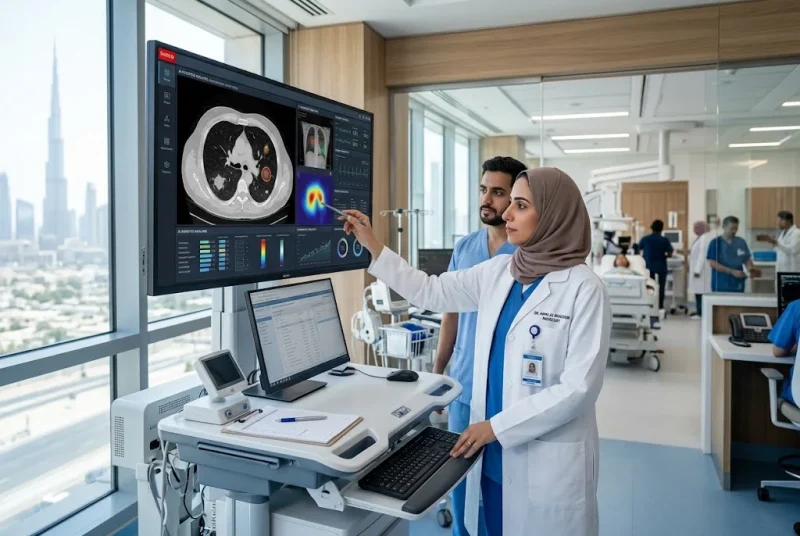

AI in UAE healthcare industry is creating new opportunities to improve patient care, support medical professionals, streamline hospital operations, and develop innovative healthcare businesses. Across the United Arab Emirates, artificial intelligence is becoming an important part of the wider digital transformation of public services and private healthcare. From medical image analysis and predictive analytics to administrative automation and virtual health support, AI can help healthcare providers make better-informed decisions when implemented responsibly.
For hospital operators, clinic owners, health technology companies, investors, and entrepreneurs, understanding this transformation is increasingly important. However, successful adoption requires more than purchasing advanced software. Healthcare organisations must consider clinical safety, patient privacy, cybersecurity, professional accountability, and applicable licensing requirements. This guide explains the major applications, commercial opportunities, challenges, and future direction of AI in the UAE healthcare sector.
What Is AI in the UAE Healthcare Industry?
Artificial intelligence in healthcare refers to computer systems that analyse information, identify patterns, generate predictions, or assist with tasks that traditionally require human judgement. These systems may use machine learning, natural language processing, computer vision, and other technologies to support healthcare delivery.
In the UAE, AI adoption fits into a broader national focus on digital government, innovation, and advanced technology. The Ministry of Health and Prevention (MoHAP) has established an AI Office to support digital transformation, operational efficiency, predictive analytics, automation, and responsible AI use. The ministry has also introduced initiatives to strengthen AI capabilities within the health sector.
Importantly, AI is generally best understood as a support tool rather than an automatic replacement for qualified healthcare professionals. Its value depends on the quality of the data, the suitability of the application, clinical oversight, and the ability to demonstrate reliable outcomes.
Key Applications of AI in UAE Healthcare Industry
1. Medical Imaging and Diagnostic Support
Medical imaging is one of the most widely discussed applications of healthcare AI. Depending on the intended use and regulatory approval, AI systems can help analyse X-rays, CT scans, MRI images, and other diagnostic information. They may flag unusual patterns, highlight areas requiring closer examination, or help prioritise cases for review.
For hospitals and diagnostic centres in the UAE, these tools can support workflow efficiency and help clinicians manage large volumes of medical information. Nevertheless, AI-generated findings must be evaluated within the clinical context. A qualified professional remains responsible for interpreting results and deciding on appropriate patient care.
2. Predictive Analytics and Preventive Care
Predictive analytics uses available data to estimate the likelihood of future events. In healthcare, suitable models may help identify patients who could require additional monitoring, support the management of chronic conditions, or assist health organisations with resource planning.
For example, an authorised healthcare provider could evaluate whether a model helps identify patients who may benefit from earlier follow-up. Such applications require appropriate data governance, representative datasets, clinical validation, and ongoing performance monitoring. Predictions should not be treated as certain outcomes or used without considering the circumstances of individual patients.
3. Administrative Automation
Healthcare facilities manage appointments, billing, documentation, patient enquiries, insurance administration, and internal reporting. AI-powered systems can assist with routine administrative work, subject to appropriate access controls and human review.
Examples include appointment reminders, document classification, workflow routing, and conversational assistants that answer approved general questions. Automating repetitive processes may allow staff to devote more time to patient-facing responsibilities. However, systems handling sensitive information must be configured carefully to prevent unauthorised disclosure or inaccurate responses.
4. Personalised Patient Support
AI can help healthcare professionals organise patient information and identify patterns that may be relevant to individual care plans. In suitable settings, digital tools can support medication reminders, follow-up scheduling, health education, and monitoring of selected health indicators.
Personalised support must remain clinically appropriate. General-purpose chatbots should not be presented as substitutes for medical consultations, and automated recommendations must not bypass necessary professional assessment. Providers should make it clear when patients are interacting with an automated system and explain when human assistance is required.
5. Virtual Healthcare and Remote Monitoring
Digital healthcare services can combine virtual consultations, connected devices, patient portals, and AI-supported information analysis. These technologies may help care teams organise follow-ups and review relevant information between appointments.
Dubai already has an established telehealth framework. AI may complement these services through appropriate scheduling, documentation, and decision-support tools, although introducing AI does not remove existing telehealth licensing or patient-safety obligations.
Healthcare businesses exploring this area should also understand the wider market for AI startup opportunities in Dubai and assess whether their proposed solution addresses a genuine clinical or operational need.
Benefits of AI Adoption for UAE Healthcare Providers
Improved Operational Efficiency
Well-designed AI systems can reduce repetitive manual work, organise information, and support more consistent administrative processes. Hospitals and clinics may use these capabilities to improve appointment coordination, manage workloads, and identify operational bottlenecks.
However, efficiency gains should be measured rather than assumed. Providers should compare performance before and after implementation, including error rates, staff workload, patient waiting times, and the resources required to maintain the system.
Better Support for Clinical Decisions
AI can process large datasets and highlight patterns that may be difficult to identify through manual review alone. When appropriately validated, these capabilities can provide additional information for clinicians considering diagnoses, treatment options, or follow-up requirements.
The benefit is not that every AI recommendation is correct. Instead, the objective is to provide useful supporting information while preserving professional judgement and accountability.
More Accessible Digital Services
Digital assistants, automated reminders, and remote-care tools may make it easier for patients to access information and navigate healthcare services. These benefits are particularly relevant when organisations design systems for people with different languages, accessibility needs, and levels of digital confidence.
Healthcare providers should maintain alternative support channels for patients who cannot or do not wish to use automated services. Digital transformation should improve access rather than create unnecessary barriers.
New Opportunities for Healthcare Innovation
The adoption of AI creates potential opportunities for software developers, medical technology companies, healthcare consultants, and specialised service providers. Possible business models include clinical workflow software, healthcare analytics, secure document processing, and technology integration for licensed medical facilities.
Entrepreneurs can explore the UAE’s wider technology ecosystem through resources covering Dubai’s development as a technology startup hub. Nevertheless, a promising business concept still requires customer validation, financial planning, regulatory assessment, and a realistic route to market.
Business Opportunities in AI-Powered Healthcare
For entrepreneurs and investors, the most practical opportunities often involve solving a clearly defined problem instead of developing a broad AI product without an established customer need.
Healthcare Software and Workflow Solutions
Developers may build appointment management tools, clinical documentation assistants, patient communication platforms, or software that helps authorised healthcare teams organise information. Before launching, founders should establish whether their product is administrative software or a regulated medical application, because its intended purpose can affect the requirements that apply.
Medical Data Analytics
Healthcare organisations may need support with data quality, reporting, operational dashboards, and properly governed analytics. Providers in this market must understand data access permissions, confidentiality, security requirements, and the limits of their contractual responsibilities.
AI Integration and Consulting
Some medical facilities may prefer to adopt established technology rather than build systems internally. This creates potential demand for implementation support, staff training, workflow redesign, integration, and ongoing technical maintenance.
Consultants should avoid promising guaranteed diagnostic accuracy, regulatory approval, or financial savings. Commercial proposals should explain the intended use, evidence available, limitations, security arrangements, and measurable success criteria.
Research and Technology Partnerships
Collaboration between healthcare providers, universities, technology companies, and research organisations can help test solutions in appropriate settings. Research projects involving patients or identifiable health information must follow applicable ethical, privacy, and regulatory requirements.
Founders can also investigate relevant funding and support options through this guide to funding opportunities for UAE startups. Eligibility, funding conditions, and availability should be confirmed directly with the relevant organisation.
Regulatory and Data Protection Considerations
Regulatory compliance is central to the responsible use of AI in healthcare. A product that works well in a demonstration may still be unsuitable for clinical use if it lacks appropriate validation, safeguards, or regulatory clearance.
Understand the Relevant Healthcare Authority
Healthcare regulation depends on the emirate, the type of facility, the proposed activity, and the nature of the technology. Dubai-based healthcare providers should review applicable Dubai Health Authority (DHA) requirements, while organisations operating in Abu Dhabi or other emirates must identify the relevant local and federal requirements.
The DHA has published a policy addressing the use of AI in healthcare services in Dubai. Businesses should consult the latest official policy and applicable updates rather than rely solely on summaries or older implementation guides.
Protect Patient Information
Health information can be highly sensitive. Before implementing an AI tool, a healthcare organisation should determine what information the system collects, where it is processed, who can access it, whether it is retained, and whether a third-party provider can use it for additional purposes.
Security controls may include role-based access, encryption, audit logs, vendor due diligence, retention limits, incident response procedures, and appropriate contractual safeguards. Data-sharing arrangements and any cross-border processing must be assessed against applicable UAE health information and data protection requirements.
Validate Clinical Performance
AI systems can produce inaccurate results, perform differently across patient groups, or become less reliable when clinical practices and data change. Healthcare organisations should establish validation criteria before deployment and monitor performance after implementation.
Where a tool is intended to diagnose, predict, monitor, or recommend treatment for a medical condition, its regulatory status should be assessed carefully. Depending on its intended purpose, additional requirements for medical software, devices, clinical evidence, or professional oversight may apply.
Maintain Human Oversight
Healthcare facilities should define who reviews AI-generated information, who can override a recommendation, how errors are reported, and when a case must be escalated. Patients should have appropriate routes to seek clarification or human review.
Clear responsibilities help prevent staff from relying on automated outputs without sufficient scrutiny. They also support accountability when the technology is integrated into established clinical workflows.
Challenges of Implementing AI in UAE Healthcare
Data Quality and Integration
AI performance depends on the relevance, completeness, and quality of its input data. Inconsistent records, incompatible systems, missing information, or limited representation of patient groups can undermine results.
Healthcare providers should assess their existing digital infrastructure before purchasing a solution. Integration with clinical systems, access permissions, data standards, and staff workflows should form part of the implementation plan.
Costs and Return on Investment
AI adoption can involve software licences, infrastructure, integration, cybersecurity, training, validation, and ongoing maintenance. Smaller clinics may find these costs difficult to justify without a clearly defined business case.
A practical assessment should estimate the total cost of ownership and identify measurable benefits. Potential indicators include administrative time saved, reduced processing delays, user adoption, system reliability, and patient experience. Financial savings should be supported by evidence from the organisation’s own operations.
Staff Training and Trust
Medical professionals and administrative teams need to understand how an AI tool works, what it can and cannot do, and how to recognise unreliable outputs. Poor training can result in underuse, overreliance, or inconsistent procedures.
Involving frontline staff during selection and testing can improve adoption. Training should be updated whenever the system, intended use, or relevant policies change.
Bias and Accountability
Models trained on incomplete or unrepresentative data may produce unequal outcomes. Organisations should evaluate whether the technology performs appropriately for the populations it serves and establish processes for investigating complaints and adverse outcomes.
Responsibility should not be left ambiguous between the technology vendor, healthcare facility, and treating professional. Contracts, governance procedures, and clinical protocols should clearly define each party’s role.
How Healthcare Businesses Can Adopt AI Responsibly
A structured implementation process helps businesses manage risks while evaluating the potential value of AI.
- Identify a specific problem: Select a measurable need, such as repetitive documentation, appointment coordination, or a validated clinical workflow challenge.
- Define the intended use: Establish who will use the system, what decisions it supports, and whether it could fall within a regulated medical or healthcare activity.
- Review vendors and evidence: Assess technical capabilities, reliability, security practices, references, limitations, and any required regulatory status.
- Check legal and regulatory requirements: Consult the relevant healthcare authority and qualified advisers before processing patient data or using the system in clinical practice.
- Run a controlled pilot: Test the solution in a suitable setting with trained users, documented safeguards, and appropriate human supervision.
- Measure performance: Track accuracy where relevant, workflow efficiency, safety incidents, user feedback, costs, and other predefined indicators.
- Improve and monitor: Review outcomes regularly, investigate problems, update training, and reassess the system when its performance or intended use changes.
This process allows a healthcare organisation to make decisions based on evidence rather than marketing claims. It also provides a clearer foundation for scaling a successful pilot across additional departments or facilities.
The Future of AI in UAE Healthcare Industry
The future of AI in the UAE healthcare industry will depend on the combination of technology, clinical expertise, responsible governance, and practical implementation. Potential developments include more advanced clinical decision-support systems, improved healthcare analytics, automated administrative workflows, and closer integration between digital health services.
Government initiatives indicate that AI and smart healthcare remain important areas of policy development. In February 2026, MoHAP reported a workshop focused on developing a national policy for smart health services and AI in the healthcare sector, highlighting priorities such as governance, privacy, data quality, cybersecurity, skills, and responsible adoption. Businesses should continue checking official announcements for subsequent policy developments and implementation requirements.
For entrepreneurs, the strongest opportunities are likely to come from products that solve genuine healthcare problems, demonstrate practical value, and meet the relevant requirements for safety and data protection. Technology alone is not a sufficient competitive advantage when healthcare providers also need reliability, integration, professional trust, and regulatory clarity.
Conclusion
AI in UAE healthcare industry offers meaningful possibilities for improving operational processes, supporting clinical decisions, strengthening digital patient services, and developing new health technology businesses. However, these opportunities must be balanced against the risks associated with sensitive information, inaccurate outputs, cybersecurity, and clinical accountability.
Healthcare providers should begin with clearly defined use cases, validate performance, train staff, and establish appropriate governance before expanding adoption. Entrepreneurs should similarly assess customer needs, licensing implications, data responsibilities, and commercial feasibility before investing heavily in a product.
With careful planning and responsible implementation, AI can become a valuable part of the UAE’s evolving healthcare ecosystem while keeping patient safety, privacy, and professional judgement at the centre of decision-making.
Frequently Asked Questions
How is AI used in the UAE healthcare sector?
Potential applications include medical image analysis, predictive analytics, administrative automation, patient communication, clinical decision support, and digital health workflows. The suitability of each application depends on its intended purpose, evidence, and applicable regulatory requirements.
Is AI in healthcare regulated in Dubai?
Yes. Healthcare facilities and relevant AI applications must comply with applicable UAE federal and Dubai-specific requirements. The DHA has published an AI healthcare policy, and businesses should verify the latest rules that apply to their particular service.
Can entrepreneurs start an AI healthcare business in the UAE?
Entrepreneurs can explore healthcare software, analytics, technology integration, and other suitable business models. However, the required licence and regulatory pathway depend on the business activity, intended use, location, and whether the product provides a regulated medical function.
Does AI replace doctors in UAE hospitals?
AI can assist with selected tasks and provide supporting information, but it should not automatically replace qualified medical judgement. Appropriate human oversight, patient safety, and clear accountability remain essential.
What are the main risks of AI in healthcare?
Key risks include inaccurate outputs, biased results, privacy breaches, cybersecurity incidents, poor data quality, and inappropriate reliance on automated recommendations. Validation, access controls, staff training, and continuous monitoring help manage these risks.
Where can businesses find official guidance on healthcare AI?
Businesses should consult the Ministry of Health and Prevention, the relevant emirate’s healthcare regulator, and official UAE legislation. For Dubai, the DHA’s published policies and regulatory circulars are useful starting points.